

Backrooms, Obsession and the Deeper Meaning of Modern Day Horror
backrooms 2.5 out of 5 sorry gang
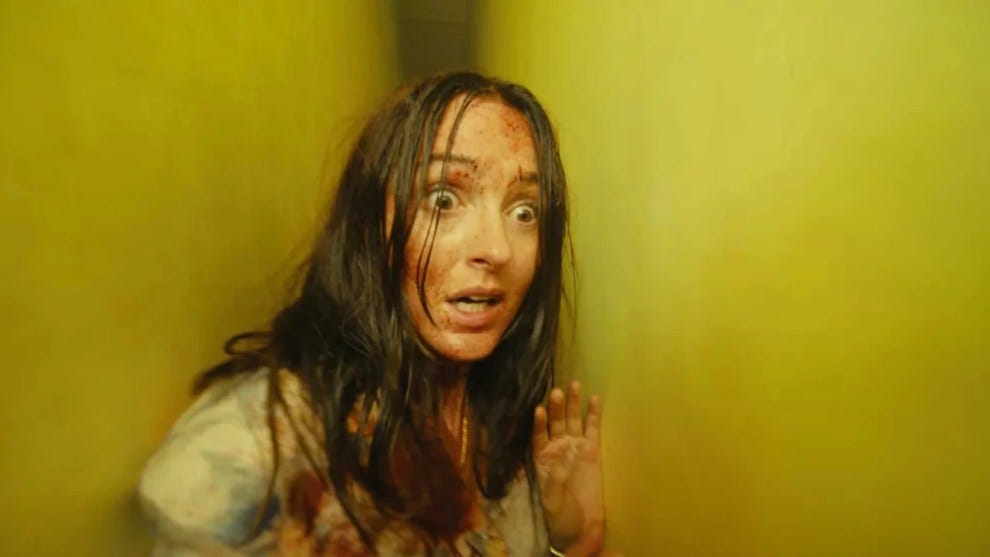
Ask anyone and they will tell you that Ariana Fountain loves a good horror movie.
And that I do, my friend. That I do.
But holy fuck, modern horror is getting boring.
On first watch, Backrooms was…not good. If you’re a fanboy, I’m sorry. Narratively, the story is flat. It runs out of steam about an hour in and spends the second and third act running in circles.
Backrooms seems determined to explain everything and nothing at the same time.
Clark is an abusive husband, a failing furniture store owner, an alcoholic, and a general sad sack. He refuses to take responsibility for his life or his behavior. Many such cases.
The climax boils down to a confrontation between Clark and Mary in which we learn that the Backrooms create copies of people, Clark has been eating said copies, and his employee’s head is sitting in a freezer for reasons the movie never seems particularly interested in exploring.
Mary essentially gives Clark permission to continue being miserable. He embraces it. Then he dies almost immediately at the hands of the monster lurking the halls.
A chase scene follows. Mary escapes. She’s captured by Async. Mark Duplass is completely wasted. A copy of Mary now exists in the Backrooms.
The extended cut includes lengthy scenes about childhood trauma that make the film feel like an entirely different movie. Part of me wonders if somebody looked at this creepy science-fiction horror film and thought:
“No. The audience absolutely needs this to be a character study.”
Because buried somewhere inside Backrooms is a much more interesting movie.
A televangelist in the 1990s struggles to untangle the web of her life and find some semblance of happiness. She stumbles into a maze-like structure and is forced to confront the one thing she’s spent her entire life running from.
And that, my friends, is a movie.
Some could argue that the entire point of the Backrooms is that you’re not supposed to understand it. Fair enough. But confusion and mystery are not the same thing.
The film is largely carried by Renate Reinsve and Chiwetel Ejiofor. By the time the credits rolled, I found myself with so many questions that I wasn’t even sure which ones I wanted answered.
Maybe that’s why the movie frustrated me.
Not because it was mysterious.
Because it wasn’t.
It felt trapped between two ideas. It wanted to be a creepy science-fiction horror film and a meditation on trauma at the same time. Instead of committing to either, it spends most of its runtime awkwardly bouncing between the two.
Which brings me to Obsession.
One of the most fascinating parts of horror fandom is watching people argue about what a movie is “really” about. The prevailing theory online seems to be that Nicky represents women with Borderline Personality Disorder. Which is certainly a take.
Despite the movie quite clearly being about a man who strips the autonomy from his female best friend and attempts to turn her into a character in his own fantasy. When she refuses to play along, he becomes resentful.
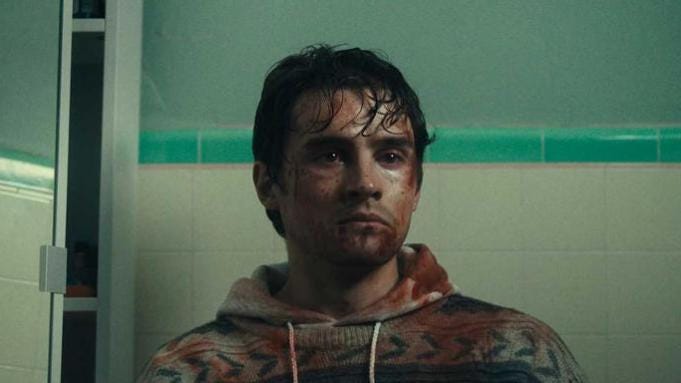
Bear comes dangerously close to cheating on Nicky because he’s bored. Exhausted. The asshole can’t even commit to suicide so Nicky can be free.
Yet somehow people still manage to walk away blaming her.
I find that fascinating.
More and more, I notice women looking for ways to blame themselves even in their media consumption. I’m genuinely not sure how an adult watches Obsession and concludes that the woman is the problem.
But that’s the difference between a two-and-a-half-star movie and a four-and-a-half-star movie.
Obsession knows exactly what it’s trying to say.
Backrooms doesn’t.
And that’s my issue with modern horror.
Not every horror movie needs to be a thesis statement.
It feels like every monster now represents grief, addiction, depression, motherhood, loneliness, self-destruction, or the entire human condition.
Get Out was revolutionary.
The movies that followed were insightful.
Now the well is starting to run dry.
Ironically, I ran into this exact problem while writing my own screenplay.
For the last six months, I’ve been working on a slasher called Halloweekend. At some point I found myself asking the same question every horror filmmaker seems obsessed with:
“What is this really about?”
Not the plot.
The meaning.
My first draft was basically a Netflix miniseries. Too many characters. Too many moving parts. Too many explanations.
I spent months trying to make everything connect.
I had the ending. I had the beginning. The middle was a mess.
By draft 10, I realized I was asking the wrong question. I wasn’t writing a term paper. I was writing a horror movie.
The horror films I love aren’t the ones desperately trying to prove how smart they are. They’re the ones that understand fear.
The original Backrooms image became an internet phenomenon because nobody understood it. The yellow walls. The fluorescent lights. The endless maze.
The possibility that something was waiting around the corner.
The moment you explain the monster, you begin to shrink it.
Sometimes a killer is just a killer.
Sometimes a monster is just a monster.
And sometimes a movie should just be a movie.
If I wanted to watch the equivalent of a ten-page paper, I’d just go on YouTube and watch a 20-something explain something to me in a 2 hour video essay.