

Should Radical Feminism Be More Mainstream?
on desire and the problem with choice feminism
I have somehow wound up on the side of Twitter embroiled in a debate about anal sex in heterosexual relationships.
Butt stuff is for boys. But I digress.
The discourse has been hilarious, but also weirdly enlightening about the current state of feminism. Man, oh man, I think women are fucked.
I am always surprised by how many women still resist the idea that patriarchy oppresses all women. Because if patriarchy is real, then it doesn’t politely excuse individual men from participating in it. That is how the system works.
What really sent people into hysterics, though, was the implication that their sex lives might be shaped by it too. Emphasis on might, because obviously there are some freak hoes out there who genuinely enjoy butt sex.
The issue isn’t really selling your body for money, taking it up the ass, or getting ejaculated on. It’s the refusal to acknowledge that these acts benefit men.
Because they do.
Within patriarchy, within power structures, within everything we claim to believe about how the world works, men benefit from women performing sexuality in ways that center them. That doesn’t suddenly stop being true because you personally enjoy it.
And you can like what you like. No one is breaking into your bedroom to stop you. Radical feminists are not hiding in your closet, waiting to confiscate your sex life.
They’re asking you a question.
Why do you like it?
And more importantly, would you like it the same way if you had never been taught to?
Which, apparently, is a radical and offensive question. Misogynistic, even. Somehow.
I thought it was just a question.
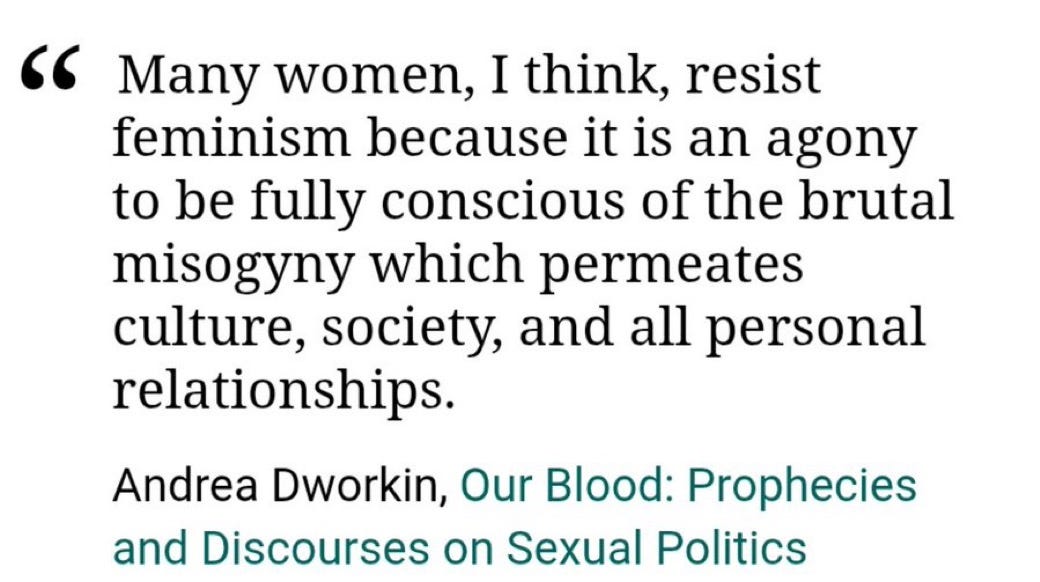
Ideologies force people to reckon with who they are. I can understand why so many women reject radical feminism: the scope of it. Many people can’t tolerate the implication that they may not be fully autonomous.
Think of it this way.
If your desire is shaped by external forces, then your identity is unstable.
If your identity is unstable, then the idea of choice becomes complicated.
If choice is complicated, then empowerment becomes complicated too.
And if you are a woman living under patriarchy, the implications of that can be soul-shattering. In a system as existentially crushing as this one, it inevitably raises the question of whether true freedom is even possible.
I think this is part of what explains choice feminism and its meteoric rise. If you choose to be degraded and disrespected, then at least it feels self-authored. And if it feels self-authored, it no longer feels like submission to power, but empowerment.
Where does this actually leave women?
Women are told that we’re free.
On June 24, 2022, the Supreme Court eliminated the constitutional right to abortion. And yet, women are still told that we can choose. More than that, we’re told that we already have.
OnlyFans models are en vogue. Sugar daddies, findom, and 304Tok have all gone mainstream. On the other end, Ballerina Farm and Nara Smith have become popular “traditional wife” influencers. Women on both ends of the spectrum are loudly, publicly proclaiming their choices.
So when women hop into my comment sections and loudly proclaim their choice to be a wife and mother, I politely make it clear that I don’t really care.
Choice feminism is a big ol’ nothing burger. You can’t “choose” to do what is already expected of you.
Men expect that you marry them and have their children. They expect that you come home, clean their house, have sex with them, and be agreeable.
And I know this to be true because women get online every single day and let us into the reality of married life.
I have yet to see a woman on TikTok who actually seems happy as a wife.
And we can agree that these structures exist. There’s tangible proof.
You can acknowledge things like the second shift—women clock out of work and then clock back into motherhood. That’s widely accepted.
So why were women dying on the hill of anal?
You can agree that patriarchy shapes labor, family structures, and expectations. But the idea that it might shape desire? Suddenly that’s absurd?
I can’t buy into that.
Women are asked to experience being adaptable, flexible, and moldable as empowerment.
The real issue isn’t whether patriarchy influences desire. It’s what it means if it does.
If patriarchy touches everything, then how does the individual woman decide where the conditioning stops? Can you even make that distinction?
The question even sends me into a spiral as I type this. This is why I’m so put off by dating. Everyone thinks I hate men or I’m anti-love, which isn’t true. I’m anti-patriarchy. Maybe that’s anti-men by design.
The truth is, I don’t know if I can love a man without wondering if he benefits more from the arrangement than I do.
By the standards of the system, he benefits from my emotional and physical labor. I’m his best friend, confidante, maid, nurse, nanny, cook, and sex puppet. That sounds really fucking exhausting. And women agree to do these things because at least they’re guaranteed a ring, or even the occasional I love you.
I don’t see that as a fair exchange. I’m not sure I ever will.
Radical feminism feels extreme because it refuses the comfort of choice feminism. It calls into question what’s sacred—love, romance, sex. In this system, those are the only things that are supposed to belong to women. And when we’re too busy dabbling in those things and arguing with each other, we run out of time to restructure society in a way that actually benefits us. In turn, this benefits men.
I understand why people reject the question. Because to take it seriously, even for a moment, is to risk realizing that the most intimate parts of your life might not be entirely your own.
And I’m not even saying they aren’t.
I’m just saying people refuse to find out.