

As I’ve gotten older, I’ve really come to hate the phrase “haters are my motivators.”
If you’re Black, there’s a 95% chance your parents or grandparents have said this to you after you came home crying because you were being bullied. Knowing people dislike me for reasons outside of my control just makes me paranoid. I never cared if they were supposed to motivate me to try harder — I just wished they would leave me alone.
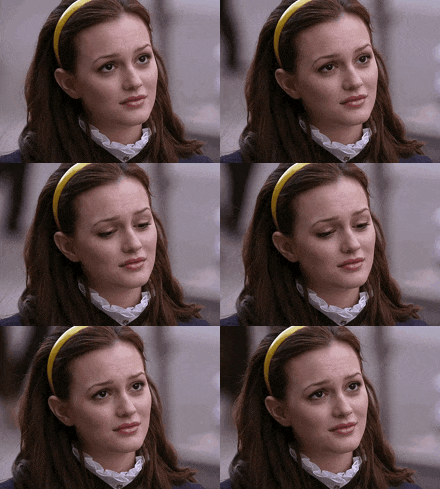
As a dedicated Gossip Girl rewatcher, it was obvious the hatred Serena and Blair shared. Serena was clearly drowning in guilt, and Blair obviously felt overshadowed by Serena.
It doesn’t help that Serena is a statuesque blonde who quite literally towered over Blair and was loved by everyone. Blair projected her deeply rooted inadequacy onto everyone around her. Serena couldn’t put her ego aside to apologize until she was finally caught.
Not only does she have sex with Blair’s boyfriend, Nate — she takes his virginity, something Blair had been intent on making special between the two of them.
And when finally confronted about it, Serena has the nerve to seem shocked and play stupid. Then, in the following episode, she has the nerve to be mad at Nate for telling Blair.

Who wouldn’t hate her?
Blair wasn’t perfect, but most of her behavior was reactionary. Imagine the people closest to you going out of their way to gaslight you and make you feel insane because they can’t be honest.
My therapist once told me the reason I hate liars is because they want to avoid accountability. I never forgot that, especially because these are usually the same people that insist on it from you.
The first time I watched Girls, I was fifteen, maybe sixteen, and in the middle of the worst crisis of my teenage life. One of my close friends knew I liked a guy in our friend group — and apparently she did too, because they started dating. Everything feels apocalyptic at fifteen, but rewatching that moment at twenty-four makes me realize we weren’t even that close. We just shared the same peripheral orbit.
Around that same time, Season 5 and 6 of Girls were airing, and I was watching Hannah get blindsided and betrayed by her best friend, Jessa. Jessa starts a relationship with Adam, Hannah’s ex-boyfriend. To be fair, Adam borderline stalks Jessa into it — he harasses her until she finally tanks her friendship with Hannah and gives in. But still: the betrayal is the betrayal.
What hits harder now is the bigger realization I couldn’t see at fifteen:
Almost all of Hannah’s friends secretly dislike her.
Whether they admit it or not.
Marnie and Jessa, in particular, are obsessed with her in that jealous, slightly repulsed, “why does she get things I don’t?” kind of way. The insecurity oozes through their storylines. Marnie, who in the pilot had the most going for her — great boyfriend, great apartment, great job — slowly loses everything and never recovers. She’s judgmental, condescending, and constantly talking to Hannah like Hannah is beneath her, even while begging for Hannah’s emotional labor. Even at the end, when Marnie “offers” to help Hannah raise her baby, it’s not out of love. It’s because she thinks Hannah is incompetent and wants to supervise her like some kind of project.
Then there’s Jessa. When she and Adam finally end up together, she says, “I’ve wanted this for a long time.”
You wanted your friend’s boyfriend for a long time? Be serious.
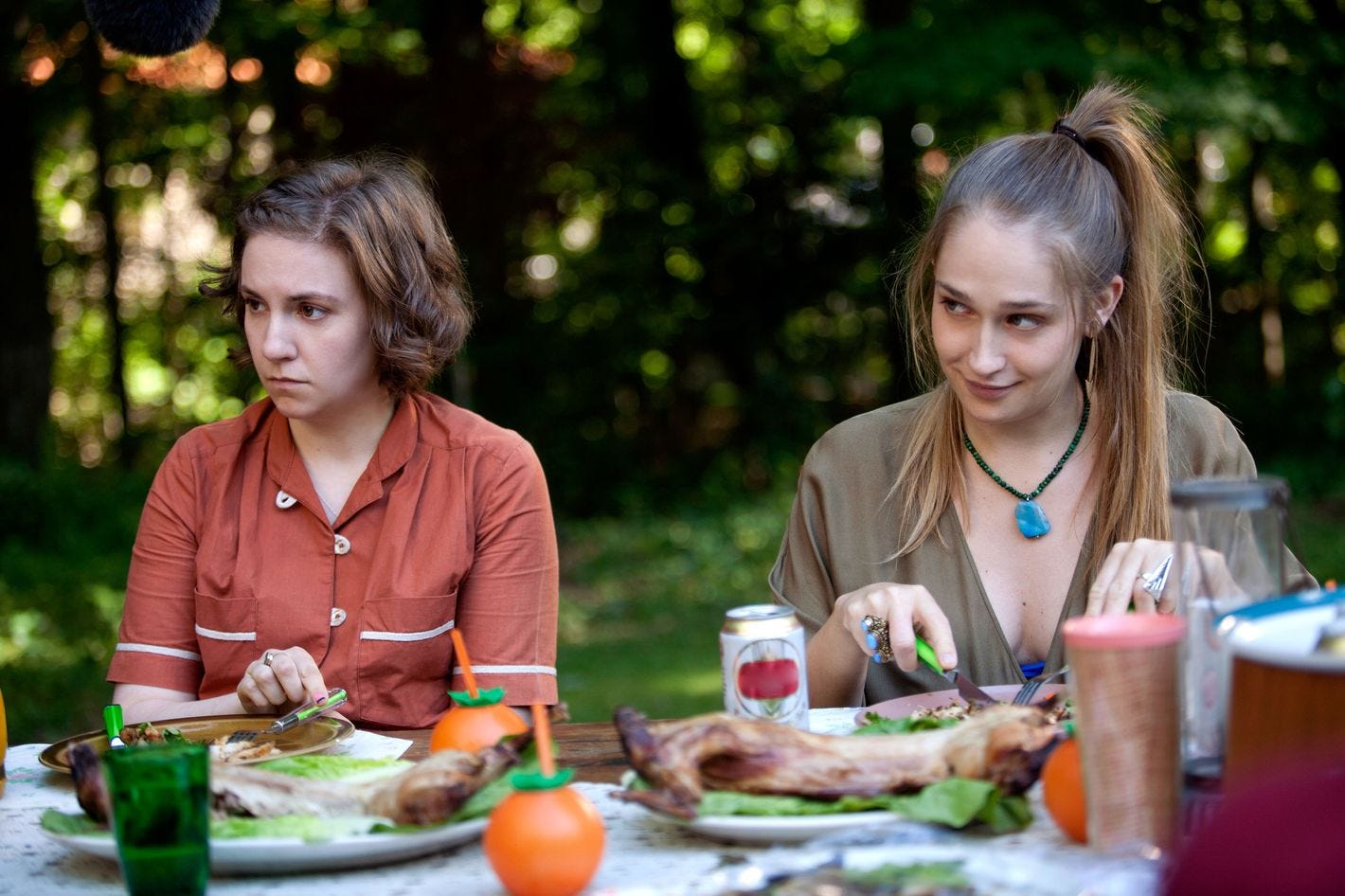
Hannah is selfish and borderline narcissistic sometimes, absolutely — but what twenty-something isn’t? Underneath the chaos, she’s one of the only characters with an actual moral center. She shows up when it matters. She picks Jessa up from rehab. She visits Jessa’s grandmother. She supports Marnie through the world’s most delusional wedding. She’s messy, but she’s not cruel.

Jessa, on the other hand, is an addict in every sense: substances, attention, destruction, reinvention. When I was in high school, I thought she was so cool — the accent, the outfits, the careless beauty, the way she floated through the world like nothing stuck to her. Now, at twenty-four, it’s abundantly clear she’s borderline sociopathic. She has always hated Hannah. She loved Hannah’s attention, not Hannah herself. She needed Hannah to adore her so she could feel superior.
And the thing is: Jessa didn’t want Adam because she loved him.
She wanted Adam because Adam wanted Hannah.
She never understood why someone like him would choose someone like Hannah. Hannah had parents who loved her. Hannah had direction, ambition, a belief in her own writing ability. Hannah could be annoying, but she was accepted as she was. Hannah didn’t need to perform a personality to be loved. That made Jessa itch.
And within a few episodes, Jessa and Adam implode. Adam — a professional Captain-Save-A-Hoe — can’t deal with Jessa’s laziness and refusal to grow up. Jessa can’t stop bringing up Hannah, spiraling every time Adam doesn’t indulge the comparison. She needs Adam to reassure her that she “won,” but he doesn’t care. He’s annoyed. He’s moved on. Hannah isn’t performing heartbreak for him, and that makes Jessa feel even worse.

And that old essay fragment of mine keeps coming back:
Jessa feels guilty because Hannah is the only person who truly sees her and loved her anyway.
Adam is furious because Hannah is no longer playing the role he assigned her.
Everyone is jealous of Hannah because everything works out for her in a way that feels unfair.
When I look back at being fifteen — my “friend” swooping in on a boy she knew I liked, the weird competitiveness, the quiet undermining — it all makes sense now. It was never about the boy. It was about proximity, jealousy, attention, and who gets to be the center of someone else’s world.
Mind you, I’m too lazy to compete. You either see me or you don’t. And if you don’t? Y’all got it.
Girl drama is fun to watch but devastating to be a part of. Jealousy and envy make me paranoid, especially when the people dishing it out can’t accept it. I never positioned myself above anyone or decided I was bigger than some program. Life can humble you faster than you can blink.
I never thought I was the girl with “fake friends.” I give people far more grace than I ever give myself because I want to believe in the good of others. I don’t know — I never even considered myself worthy competition. I’m broke 85% of the time and I’m in serious debt. I just show up as myself and decide people either like it or they don’t.
I don’t put on a performance because I don’t even know you, so why would I care if you like me? Y’all aren’t very impressive to me either.
Apparently, this reads as self-righteous, but I can’t help that. Sorry.
There’s a specific kind of girl who gravitates toward confident people because she wants to absorb something from them. She’s drawn to the parts of you she secretly wishes she had — your ambition, your sense of direction, your ability to bounce back. She’ll praise those qualities while slowly resenting them. And because she doesn’t actually believe she deserves good things, she’ll convince herself you don’t deserve them either.
It’s a very Jessa energy:
I want what you have, but I also want you to think you don’t have anything at all.
Once you start paying attention, you notice the subtle digs, the weird tone shifts, the “be realistic” warnings delivered with a smile. You notice when someone only feels empowered if you’re insecure. You notice how quickly they become irritated when something finally works out for you.
And maybe Hannah’s biggest lesson — the one I didn’t understand at fifteen — is that not every friend you love is capable of loving you in the same way. Some girls need you to stay small so they can feel big. Some girls only understand intimacy through competition. Some girls can’t be happy for you because they think your happiness is an attack on their identity.
My favorite scene in the show is when Jessa attempts to reconnect with Hannah after finding out she’s pregnant. Hannah finally tells Jessa she doesn’t really care about her anymore. Jessa tearfully exclaims she can’t just cut her out. Hannah shrugs.
It’s funny how people finally show up once you’re done being devalued.
What I’m learning in my mid-twenties is that it’s not my job to convince anyone I’m worthy of basic respect. I don’t need to audition for friendship, and I don’t need to shrink so someone else can feel comfortable standing next to me. I can love people and still walk away once I realize their affection is conditional. I don’t have to wait around to be chosen. I can choose myself and let the rest fall away. Some endings aren’t betrayals — they’re clarity.