

The Popstar as Myth: Katy Perry and the Death of the Teenage Dream
How the Death of Monoculture Turned a Popstar Into a Relic
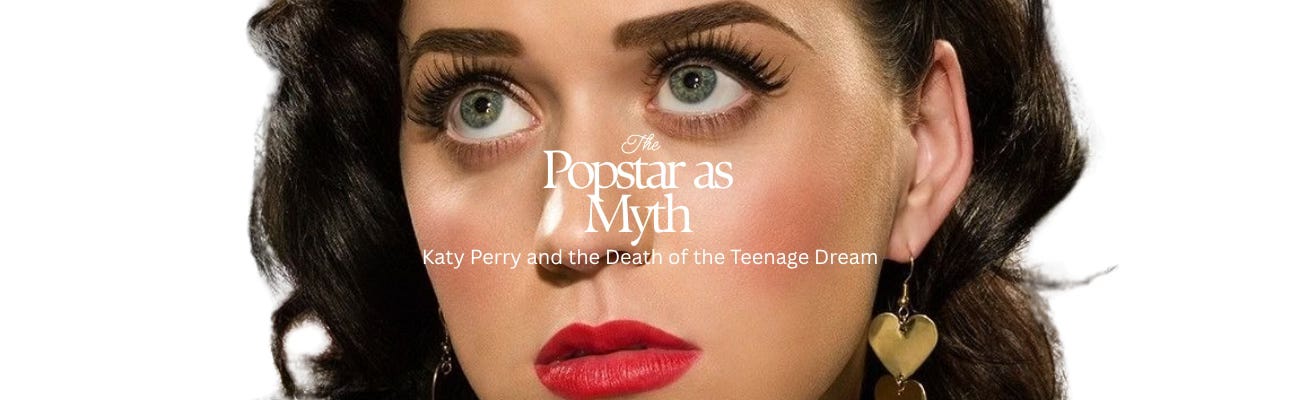
i. artifact
Katheryn Elizabeth Hudson is a historical millennial artifact.
Katy Perry represents the myth of the former popstar: a body optimized for output, shaped to meet the demands of a system that valued consistency over individuality. She worked hard and she worked fast. The work was polished, effective — always good, if not always great.
But that was never the point.
Katy Perry did not need to be exceptional. She needed to be believable.
She emerged alongside powerhouses — Britney, Christina, Gaga, Rihanna — women whose presence could carry imperfection through sheer force of personality. Katy was different. She was not selling herself as a singular force. She was selling a world.
She was hyper-engineered into teen pop perfection: a fully realized fantasy built for maximum cultural impact. And for a time, it worked. Not because she was irreplaceable, but because the system didn’t require her to be.
A good popstar is a myth. She is iconic, distant, impossible to fully read. You know only what she allows you to know.
Katy Perry existed within that distance. Albums arrived on schedule. Singles dominated radio. The visuals were bright enough to distract from the machinery underneath. There was no room for failure, because failure would expose the illusion.
ii. the old pop system
The youth crave the idea of monoculture.
The rise of the internet, streaming television, and music subscriptions have all weakened the shared cultural experiences that once made pop culture feel communal. We rarely experience anything together anymore. We consume privately, algorithmically, and constantly.
And don’t get me wrong — I love my Spotify account. I have playlist-making down to a science. But what does individualized media consumption do to a society? What happens to the institutions that once made culture a group activity?
They become obsolete.
Movie theaters aren’t “making money,” so why bother investing in them? Malls aren’t “necessary” because you can shop online and have something at your house the same day. You don’t need CDs, DVDs, magazines, or books because everything can be pulled up instantly with the tap of a finger.
It sounds convenient because it is convenient. But convenience removes the ritual.
The joy of picking out a CD or going to Blockbuster was not just the object itself. It was the walk there. The drive there. The conversation in the aisle. The cashier. The food court. The overheard song. The shared boredom. Even if you went to the mall just to sit for an hour and window shop, you still left your house.
That world is what made artists like Katy Perry so profitable.
Twenty years ago, you knew almost nothing about the celebrity you loved. You had to flip open OK! or People magazine in the CVS checkout line for a status update. I remember being eight years old and begging my mother to buy me Teen Beat because there was a first look at The Twilight Saga: New Moon, and I just had to have it.
Now I follow IndieWire, Variety, Film Updates, and DiscussingFilm. I get every update on my phone while I’m at work or on the treadmill, alone, instead of standing next to other people in Barnes & Noble.
To become a myth, you had to surrender part of your identity to the machine.
iii. sugar, spice, and everything kinda nice
Not everyone knows this, but Katy Perry’s first album was not 2008’s One of the Boys.
It was Katy Hudson, a 2001 Christian rock album that sold roughly 200 copies before her label went bankrupt.
In 2005, she somehow landed on The Sisterhood of the Traveling Pants soundtrack, sounding like an Alanis Morissette echo. Then, in 2008, she finally became Katy Perry and struck gold with “I Kissed a Girl.”
By 2010, she released Teenage Dream.
To understand the scale of Teenage Dream, you partially had to be there. From 2010 to 2012, there was not a pop radio station you could turn on without hearing one of its singles. It was everywhere: the mall, the car, the pregame, the school dance, the radio station playing quietly in a waiting room.
Critics called it hollow, and honestly? Sure. It was hollow. It was interchangeable pop music that almost any attractive mid-twenties woman with enough charisma could have sold.
But that was also why it worked.
The lyrics were generic enough to belong to everyone. The hooks were immediate. The beats were addictive. It was not unique, but it was perfect.
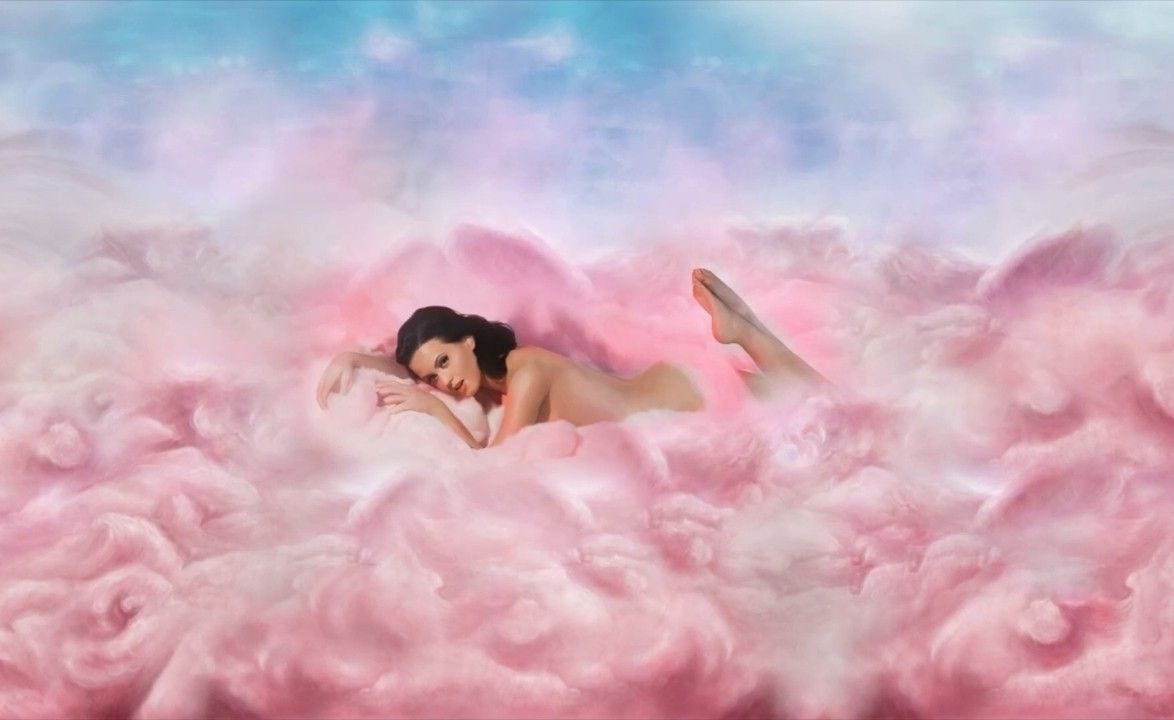
Teenage Dream was sugar, spice, glitter, sex, and EDM beats in a post-Obama election world. People wanted color. They wanted escape. They wanted to party. And “E.T.” by Katy Perry was absolutely getting played during your pregame.
The idea of Katy Perry was cohesive. She released albums quickly, toured constantly, recorded in between, and maintained the illusion of frictionless pop stardom.
And in the middle of all of this, I cannot tell you much about Katy Perry tabloid fodder. Russell Brand? Orlando Bloom? Sure. But the closest the façade came to visibly cracking was when Russell Brand divorced her by text minutes before she was due on stage.
Even then, the machine absorbed it. Critics called Katy Perry: Part of Me sharp brand management, not a true portrait of Katy the person.
That is the point.
Katy Perry was not built to be known. She was built to be consumed.
iv. the missing “toxic”
Katy Perry had hits. That’s not the issue.
The issue is that none of them ever became identity.
She never had a “Toxic.” Not just a hit, but a moment — something so specific, so inseparable from the person performing it, that it collapses the distance between the music and the artist.
“Toxic” doesn’t just belong to Britney Spears. It is Britney Spears. You can’t separate the two.
Katy Perry’s music doesn’t work like that. But nothing fully attaches itself to her as a singular presence. The identity never locks in.
The world expands, but the person doesn’t. And that was fine — for a while. Because the system only required her to be convincing.
But once that system began to collapse, the limitations became visible.
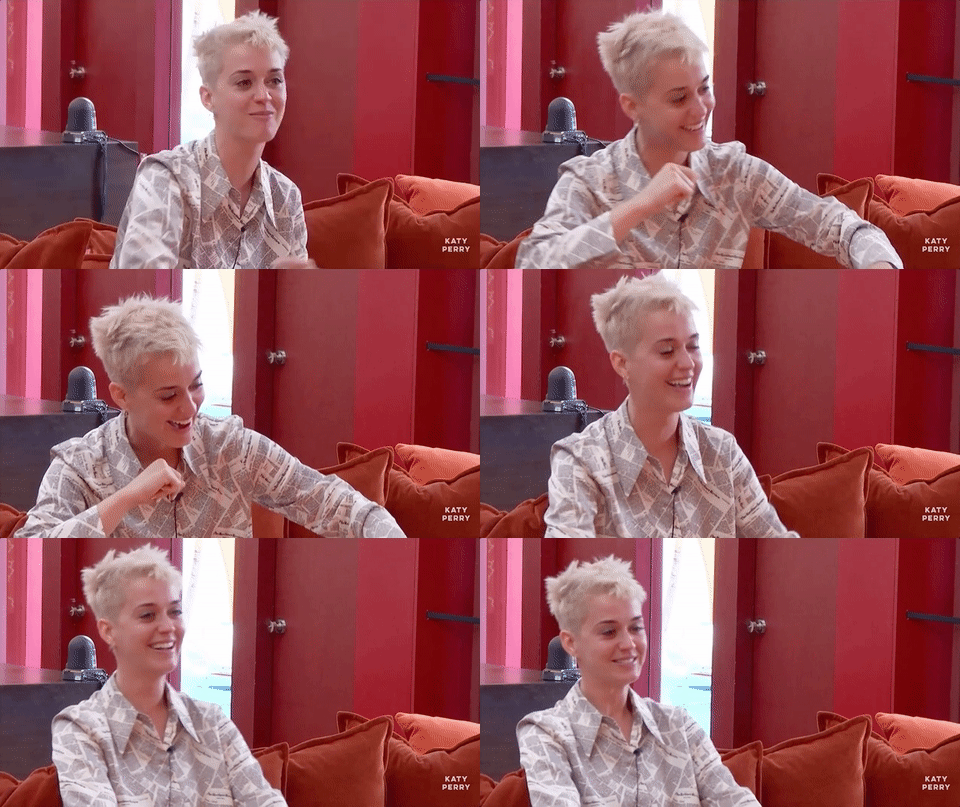
In 2017, Katy Perry released Witness — a visible attempt to shift, to become something more legible as an “artist.” She cut her hair, went blonde, leaned into self-awareness. It didn’t land.

Not because the music was bad. Not because she wasn’t trying.
But because the version of Katy Perry that worked was never built for that kind of transformation.
She was built for saturation and not evolution.
So when the culture began to demand something more — more personality, more specificity, more presence — there was nothing for her to fall back on except the system she had already mastered.
And by then, it was gone.
That’s why her career feels strange in hindsight.
It’s massive. It’s undeniable. And somehow, it’s weightless.
And as monoculture disappeared, so did the conditions that created Katy Perry. Social media didn’t make her insincere. It made the performance visible.
And once the performance is visible, belief becomes optional.
I came across your essays on TikTok, and I knew they would be interesting because your titles were so well put together. I'm so glad I stopped because this is such a well-written analysis, can’t wait to read more !