

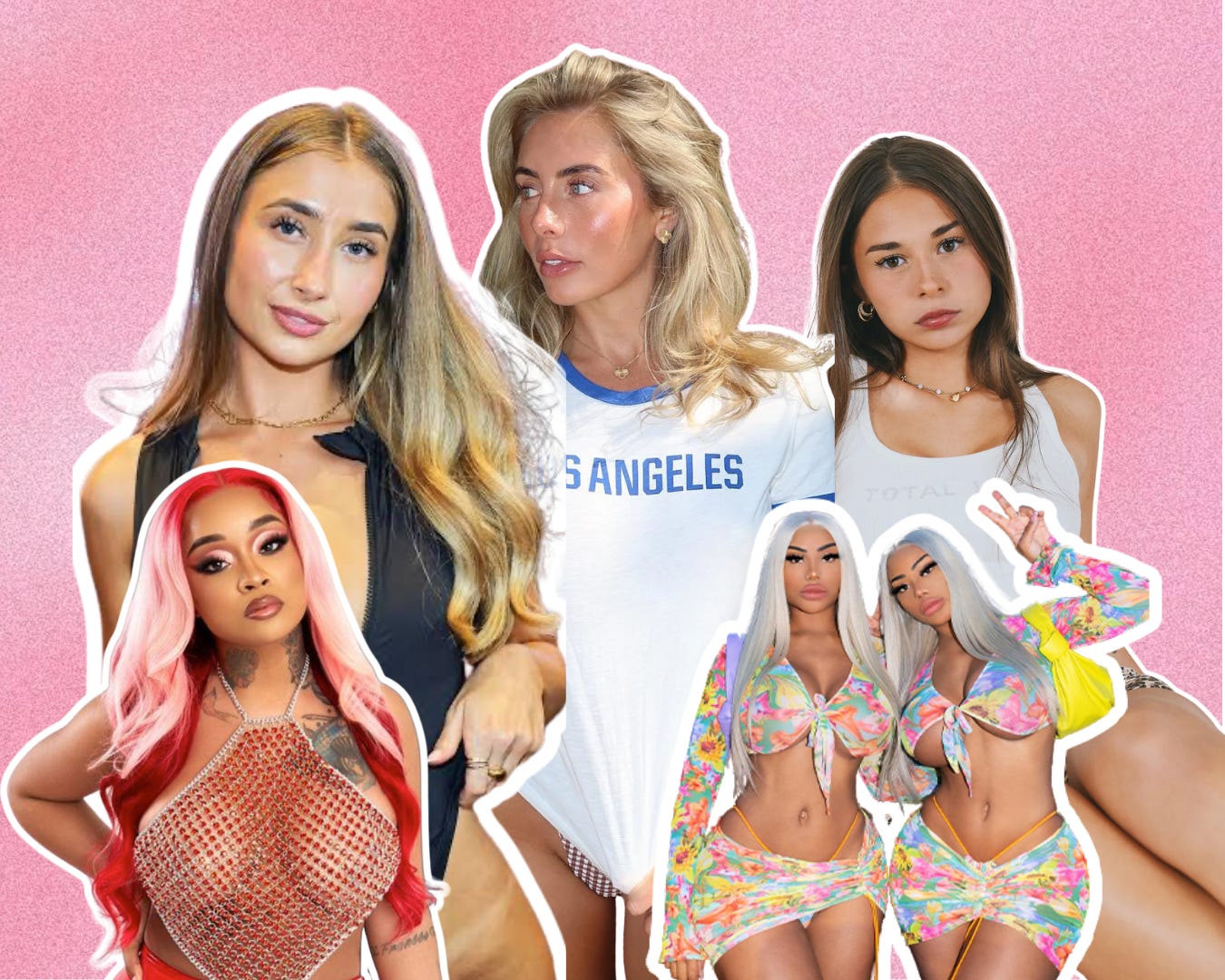
I never thought I would see the day where the OnlyFans market would be oversaturated. It used to be risqué to show your body online. Now I just roll my eyes and keep scrolling.
Yes, another photo or video of someone masturbating or showing dick and balls on my timeline for no apparent reason. I don’t dabble in the sex economy, but Elon Musk’s Twitter algorithm seems to think I do.
And it’s not just oversaturation — it’s normalization.
i. the porn star as persona
Once upon a time, porn used to be a role.
You clocked in, had sex on camera for money, and then clocked out. Maybe you were good enough to win an award or ten. You had a stage name, the wider industry, and a separation of space between yourself and the consumer.
In fact, I had to do some light research to even write this essay. I’m not talking about the Mia Khalifas and Sasha Greys of the internet age — beautiful women with “stained” brands. The internet regularly reminds Mia Khalifa that they think she’s a slut. But even then, there was still a distinction. She was known for something she did, not something she was expected to be at all times.
In the 70s, 80s, and even early 90s, the emphasis was on performance, not identity. There are dozens of porn stars from the Golden Age who are either dead or successfully made a career pivot. They still work in adult entertainment in some capacity, became authors, or quietly disappeared from the public.
An example of this would be former adult film actress Stacy Valentine. According to Wikipedia, she was a hit in the 90s for about five years and retired quietly. She used the onset of her fame to escape her creepy husband. As I was reading, I still couldn’t help but wonder what the hell happened to all of these women. Stacy Valentine is pretty much absent from the internet. There’s no Instagram, TikTok, or even Facebook attached to her name. There is a lonely LinkedIn profile — for the past 20 years, she’s been the West Coast Creative Director for Penthouse.
There is a sort of half-interview from 2000 that I found. The interviewer more or less provides his personal opinion of Stacy rather than an actual interview. The ending is supposed to be hard-hitting, and it is, but from a man it feels less like cultural commentary and more like misogyny.
Where do we go from here?
Porn used to be story-driven productions that eventually ended in sex. They were even played in theaters. To me, it seems like it used to be a classy party.
Now, porn is everywhere. And I mean everywhere.
The goal is no longer to create something — it’s to produce as much as possible, as quickly as possible. Cut the costs, cut the production, go bigger and get better. Faster production means quicker money.
Therein lies the problem.
ii. the collapse into identity
Instagram has always been a way to promote your image. It’s essentially a shopping app with a social media function.
Twitter seems to be where the real money is, though. Every comment section is contaminated with porn bots. I’m not sure if these are real people that get paid, AI, or what. You can search “cupcakes” on Twitter and the first video will be someone shoving a cupcake up their ass.
That’s the point. Sexual content is no longer contained. It doesn’t live in its own category anymore. It bleeds into everything else.
Once that boundary disappears, so does the distinction between performance and identity. The porn star used to have a role. The influencer just has a feed. What used to be labor is now presented as personality.
Take Instagram — there’s the IG Baddie, and then there’s the woman who is more explicitly selling access to her body. But visually, the difference between the two is getting harder to locate. They use the same poses, the same lighting, the same language of desirability. One is called branding. The other is called sex work. Sometimes the only real difference is whether a paywall is involved.
There are plenty of women online whose feeds function as a kind of public advertisement — not always explicitly, but obviously enough. Music, modeling, reality television, influencing, and paid sexual access no longer feel like separate categories. They collapse into one another.
The performance is still there. It just no longer calls itself one. The market is built around male desire — constant, immediate, and frictionless. Almost zero input but maximum output. This trend extends beyond the digital and into everyday life. How much labor can be extracted from a woman with minimal effort?
iii. porn as lifestyle
We see it in the bodies of the women that spent thousands of dollars on themselves.
BBLs, filler, breast implants, liposuction. Nipping and tucking every detail into precision. It’s almost a caricature of what is feminine. And it dominates online spaces.
The women of Zeus Network’s Baddies franchise. Joseline Hernandez. Nicki Minaj. Kylie Jenner. Kim Kardashian. Blac Chyna. On and on and on.
Instagram culture sells the dream that porn used to. If you promote this brand, they’ll give you the clothes for free. If you go to this basketball game, you can sit courtside. If you get on this yacht, you’ll be famous. If you just have sex on camera this one time, we’ll give you $10k and you can finally run away from your abusive home.
We are so consumed by sex as a culture. It’s not a coincidence that red-pill content has become extremely popular over the last ten years. It’s also not hard to understand why Gen Z doesn’t want sexual content in their entertainment. We already see it doing something mundane like scrolling Instagram or Twitter. Occasionally on TikTok, you’ll scroll past a livestream of someone having sex. It’s so abundant that it feels practically automated.
iv. the end
Porn used to be a thing you consumed in private. Magazines. VHS tapes. It was “hard” to get and exciting when you could. The internet age made it constantly accessible all the time. And I think it’s hindered us as a society.
Sex used to be something you had to go out and seek. You had to learn how to function socially and talk to people like they were human. Sex is no longer “special” and I’m not sure it ever really has been. Sex is constant. Sex appeal. Sex acts. Followers. Money. Branding.
And for all of our supposed liberation, sex is still not neutral. Under patriarchy, it still operates unevenly. It still asks more of some people than others. That is part of why Gen Z’s avoidance makes perfect sense to me. If sex continues to function as labor — social, emotional, physical, aesthetic — then opting out stops looking like repression and starts looking like self-protection.
This is why women report bitterness about dating and why men complain of loneliness. Men get power. Women get stuck with the labor. The system isn’t producing connection — it’s producing imbalance. There’s those of us who are fucked and those who do the fucking.
And my point in all of this — and every single one of my essays — is wondering where this leaves women. I wonder where this leaves me.
If porn and sex become automated — shaped by the structure of patriarchy — how does this affect women?
Are we constantly expected to “put out” in this system? Are we expected to participate in our own objectification?
How do I approach intimacy?
Is the constant access to sexual content — and the “better,” or “other” woman — why I avoid it?
I don’t think I have an answer yet.